

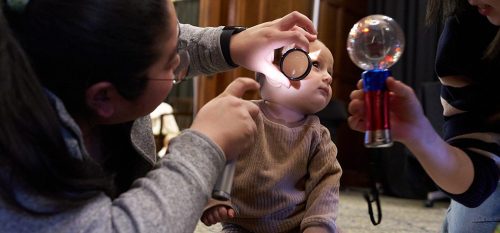
What Is an Ophthalmoscopy Exam?
When you visit your eye doctor for a routine eye exam, you may hear them mention a procedure called ophthalmoscopy. But what is an ophthalmoscopy exam, and why is it important?
At New England College of Optometry (NECO), we train future optometrists to use this essential diagnostic technique to examine the inside of the eye and its blood vessels. Ophthalmoscopy is a powerful tool that allows providers to detect early signs of and screen for eye diseases and conditions—and even uncover larger systemic health issues.
When is it Used?
An ophthalmoscopy exam (also called fundoscopy) is a non-invasive eye exam that allows your optometrist to look inside the eye, specifically at the retina, optic nerve, blood vessels, and macula—all critical components for healthy vision. Because the eye is the only place in the body where blood vessels can be seen directly, ophthalmoscopy can even provide clues about systemic diseases like diabetes and high blood pressure.
This test provides a detailed view of the fundus, or the back portion of the eye. Because many eye and systemic conditions can begin with changes in the retina or optic nerve, ophthalmoscopy is a key part of any comprehensive eye exam in helping detect damage or other conditions.

Administering the Exam
An ophthalmoscopic exam is quick and painless. Your eye doctor will first take a family history and ask about your own medical history. Afterwards, they may elect to examine your eyes using a number of different methods. First might be a direct examination in which a handheld tool with a light and magnifying lens can see a direct magnified view of the retina and optic nerve.
They may also administer an indirect exam that uses a head-mounted light and a handheld lens to examine the retina in more detail, especially in patients with cataracts or other media opacities.
Lastly, there is a slit-lamp exam that combines a microscope (slit lamp) with a high-powered lens to see a detailed, three-dimensional view of the back of the eye. This type of exam is often used with pupil dilation for maximum visibility. Depending on your exam, your optometrist may use one or more of these techniques—often after dilating the pupils with special drops.
At NECO, ophthalmoscopy is a core skill in our clinical education. Students receive hands-on training using both traditional and advanced imaging techniques to detect subtle signs of disease.
Schedule Your Comprehensive Eye Exam
Has it been a while since your last eye checkup? If you’re living with diabetes, high blood pressure, or simply want to protect your long-term vision, schedule a comprehensive eye exam that includes ophthalmoscopy.
Visit necoeyecare.org to make an appointment with one of our expert clinicians or student doctors supervised by faculty. Your eyes—and your overall health—deserve the best care.