When it’s Time to See Your Eye Doctor

Things looking blurry? It might be time to visit an eye doctor. Read on for tips and information about finding the perfect pair of glasses.
If your eyes are feeling tired, it may be time to visit your optometrist. Blurry vision, squinting, double vision, hazy vision, eye strain, or seeing halos are all signs of a potential problem. But don’t worry, you’re not alone. According to the National Center for Health Statistics, 63% of adults say they use some form of corrective eyewear, and more than 92% of people aged 65 years or older reported using glasses.
While many people know that an optometrist can prescribe glasses and contacts to manage refractive error and improve your vision, your optometrist is also an integral part of managing your overall health. Optometrists can even investigate the back of the eye (the retina) and monitor systemic conditions like diabetes or hypertension.

Far-sightedness
Hypermetropia, also known as farsightedness, is a common refractive error where distant objects are seen more clearly than close ones. Symptoms of hypermetropia include difficulty focusing on near tasks like reading or using a smartphone, eye strain, headaches, and occasional blurred vision. An optometrist can diagnose hypermetropia through a comprehensive eye exam and prescribe corrective lenses, such as eyeglasses or contact lenses, to adjust the focal point and improve near vision. Regular eye exams are crucial for detecting hypermetropia early and ensuring effective management to maintain clear and comfortable vision.
Near-sightedness
If you have blurry vision when looking at things far away, you’ll also need to see an optometrist who can determine the proper prescription. Blurry vision at distance is caused by myopia, also commonly known as “near-sightedness.” Visiting your optometrist will get you back to seeing 20/20 at distance.
Presbyopia
The Mayo Clinic defines presbyopia as the eye’s progressive loss of the near-focusing ability due to aging, is another form of “farsightedness.” Your optometrist will be able to tell you what magnification readers to buy, or if you need a prescription for glasses.
Your optometrist will be able to tell you what magnification readers to buy, or if you need a prescription for glasses
Over-the-counter readers won’t work for everyone with presbyopia, however. Some patients may have an eyeglasses prescription with astigmatism, requiring a pair of prescription glasses which may be ordered through your optometrist’s office. Though the word sounds scary, astigmatism is completely normal. According to the Journal of Current Ophthalmology, 40% of adults have astigmatism. Astigmatism is due to a rotational asymmetry in the eye’s refractive power.
Can’t I just get over-the-counter reading glasses at my local pharmacy?
Well, it depends. Over-the-counter readers are helpful if you’re experiencing blurry vision while viewing things at arm’s length, like reading or texting. Around the age of 40, the vast majority of individuals start developing presbyopia. Around this time, you’ll notice your eyes feeling tired or strained more often. You may even find yourself increasing the font size on your computer monitor to compensate. This is a sign that you are due for a visit to the optometrist.
Around the age of 40, the vast majority of individuals start developing presbyopia
Sometimes simple magnification is all that’s required. But since it’s good practice to get your eyes checked annually, go ahead and make that appointment with your local optometrist who can confirm whether readers are appropriate.
What if I’m struggling to see both near and at a distance?
This is completely normal. Luckily, you can get a pair of glasses to help you see at distance and a separate pair for near. But there are other options: many patients with presbyopia, as well as myopia, will choose to have bifocal or progressive lenses, and this technology has come a long way in the past ten years.
Bifocals
Bifocals are glasses with a segment on top for looking at distance, and a different lens on the bottom for near. These glasses are pretty distinguishable, as you can see a line where the distant prescription changes to a near prescription.
Progressive
Progressive glasses have a distance and near section, but the distance prescription slowly changes into near prescription, leaving no discernable line.
Ordering Prescription Glasses
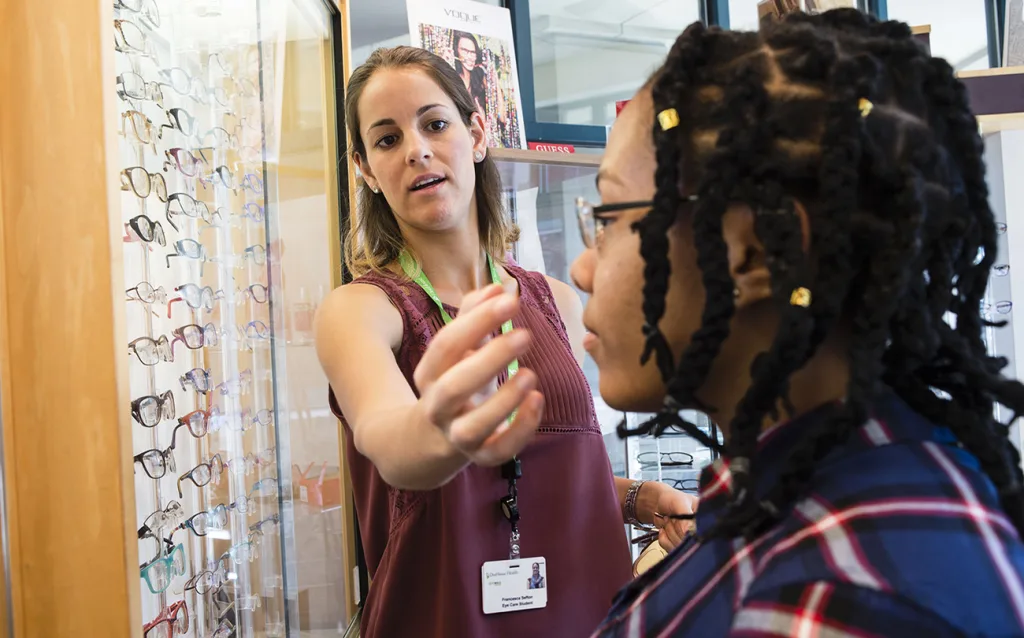
Optometrists often utilize the skills of an optician to help you pick out and purchase your glasses. This is usually someone working in the same practice, or your doctor may refer you to a different office. The optician won’t write you a prescription or offer any clinical advice, since their role is similar to a pharmacist when you go to fill a prescription at a pharmacy.

Your optician will check if your insurance covers the eyeglass frames that you’ve chosen and explain your options for filling your prescription. They will also take measurements to ensure your glasses fit well and that your prescription is centered correctly in the eyeglasses.
 “As an optician, my goal is to ensure every patient leaves with eyeglasses that not only improve their vision but also fit comfortably and complement their personal style,” says Eva Laboy, LDO, a licensed optician at NECO’s Center for Eye Care at Commonwealth. “We work closely with optometrists to understand the specific needs of each patient, ensuring the prescription is perfect and the frames are suitable for their lifestyle. It’s a collaborative effort to enhance both the vision and confidence of our patients.”
Opticians have a great sense of style and can help you choose which frames are a good fit for your face shape. When you find the perfect eyeglasses, the optician will order them, work with your insurance, and collect payment. And if you haven’t been to an optical store in a while, you’ll be amazed by the number of top fashion designers who sell unique eyeglasses. You’re sure to find a style that fits your personality!

Once you start wearing your glasses, you may notice some normal wear and tear: maybe a loose screw where the frames meet the sides of the eyeglasses, or you may feel that your glasses aren’t sitting correctly on your nose. If that’s the case, just return to your optician to get a quick adjustment of your eyeglasses for little to no cost.
Remember: your optometrist is there not only to prescribe correct lenses, but to treat you holistically and help you maintain your overall health. Never hesitate to call your local optometrist for an appointment: let them help change the way you see the world!
Other Optometric News