

The Importance of Keratometry
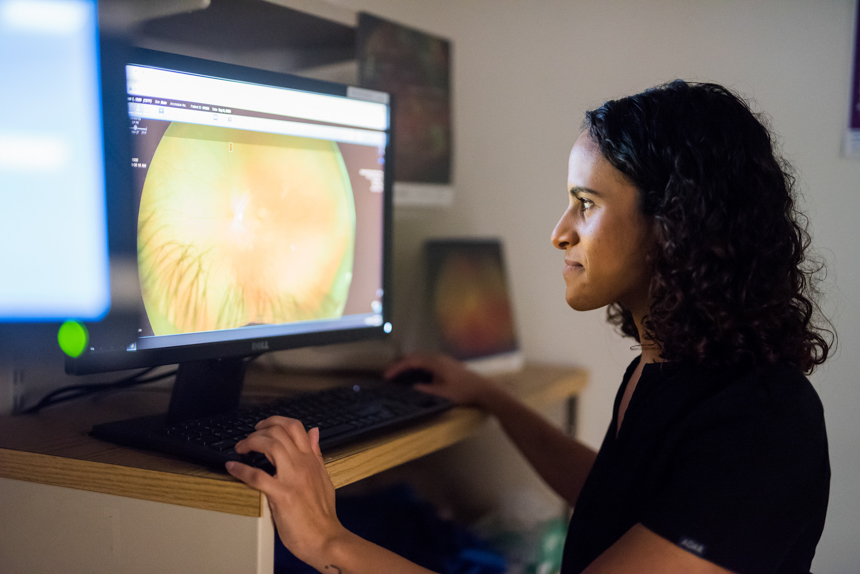
For many optometrists, measuring the curvature of a patient’s cornea is an important procedure in understanding how a person sees the world. Keratometry (K) is the clinical term for such measurements. The cornea is the clear front surface of the eye that bends (or refracts) light rays as they enter the eye.
Just like the measurement of a round object is referred to as the “circumference,” keratometry takes the measurement of the cornea’s curvature. This curvature determines the focusing power of a person’s eye and is crucial for understanding their vision and contact lens fitting.
For clear vision, the cornea must have the correct shape and power to focus incoming light rays precisely on the retina at the back of the eye. If the cornea is too steep, too flat, or irregularly shaped, it cannot bend light at the angle needed to focus on the retina. If someone is nearsighted, the cornea’s shape causes incoming light rays to focus in front of the retina. This unevenness is what happens when someone suffers from astigmatism.
Measuring and monitoring
An optometrist will measure corneal curvature using one of two methods: manual or automated. Manual keratometry utilizes a specialized instrument called a keratometer that shines a light on the cornea and measures the reflection. Automated keratometry uses different machines to take these measurements electronically. These precise measurements help eye doctors determine the best vision care, especially when it comes to ocular treatment.
Keratometry is an important component to contact lens fitting, especially gas permeable lenses that sit directly on the cornea. By getting a correct measurement of corneal curvature, optometrists can accurately fit a patient’s contact lenses for optimal vision.
Detecting any curvatures may sometimes point to a condition called keratoconus. This degenerative disease causes abnormal steepening (and irregular astigmatism) of the cornea. It can lead to reduced vision, scarring, and potential tearing of the cornea. If keratometry readings are outside of a normal range, then that may point to the potential pathology of keratoconus. However, the sooner this is identified, the sooner a patient can be treated to slow down the progression of corneal steepening.
Treatments for patients
If abnormal keratometry measurements are detected, an optometrist may recommend different procedures to alter the curvature of the cornea. These procedures are meant to ensure that all light is refracted at an angle, allowing it to focus precisely on the retina. Such a procedure may eliminate the patient’s need for eyeglasses or contact lenses, or even reduce the strength of a prescription. In the early stages of keratoconus, optometrists might be able to correct vision problems with glasses or soft contact lenses. Later, patients may be fitted with rigid, gas permeable contact lenses or scleral lenses. Patients interested in any corneal modifications should first have a comprehensive eye examination to evaluate their eye health and determine their vision needs.
There are many treatment options for an irregularly shaped cornea. It is important to find an optometrist who is trained in these options. These treatments are sometimes the exact reason why people choose to be an optometrist, they make a direct impact on how a person sees the world.