

Finding New Passions Through Residency & Community Health

For many optometry students, deciding what to do after graduation is a difficult choice with many options to consider. Each year, about 500 of optometry school graduates across the country choose to develop advanced clinical skills in a focused area of the profession by pursuing residency training.
NECO offers a wide variety of residency opportunities with 43 residency positions in 20 affiliated residencies throughout New England. Recent graduates interested in developing expertise in cornea and contact lenses, ocular disease, pediatric optometry, primary eye care, or vision rehabilitation are welcomed to apply to programs for an opportunity to see challenging patients under the mentorship of experienced clinicians.

“Each year, NECO welcomes recent graduates from around the country to our residency programs,” says Dr. Nicole Quinn, Director of Residencies and Professor of Optometry at NECO. “Our residents are exposed to unique and challenging clinical cases under the mentorship of experienced optometrists.”
Learning and Growing in Community Health
The Residency in Ocular Disease at the Dimock Center, which has an emphasis in Community Health and Primary Care Optometry, hosted its first resident in 1994. Dimock was the first Community Health Center to host an optometric residency, followed by DotHouse, in 1995.
These programs give resident optometrists unique clinical experiences focused on diverse patient populations with complex medical diagnoses.
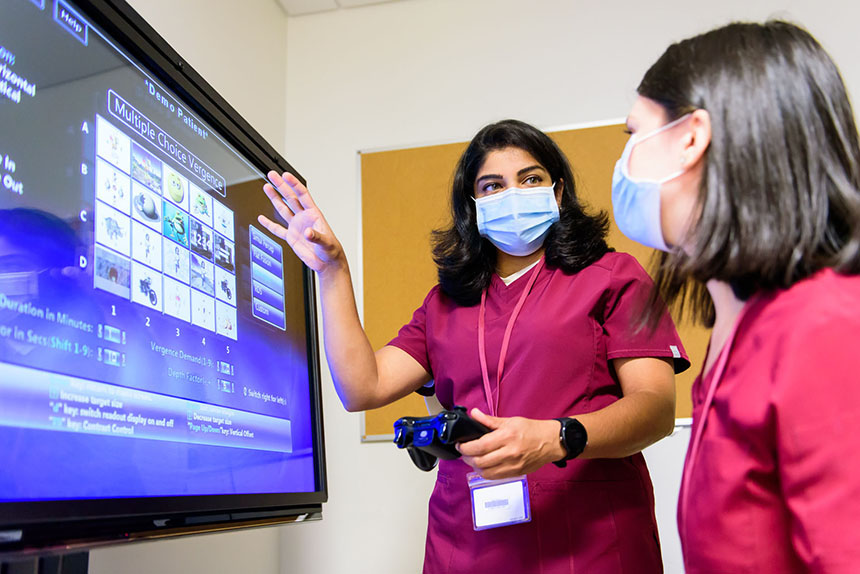
The goal of the residency program at Dimock is to equip doctors with the skills and knowledge of multiple specialties and prepare them for an interdisciplinary approach to care. For Dr. Nicole Pogue, NECO Assistant Professor of Clinical Optometry and current Director of Optometry Services at the Dimock Center, applying and enrolling in NECO’s Ocular Disease Residency changed the trajectory of her professional and personal journey.
Dr. Pogue’s Journey from Optometry Student to Resident to Director
“I discovered optometry when I started to wear glasses in the eighth grade,” recalls Dr. Pogue. “My time interacting with optometrists and seeing how they really made a difference in people’s lives pushed me to pursue optometry as a way to combine my love of science and helping others.”
Dr. Nicole Pogue earned a Doctor of Optometry degree from the University of Missouri, St. Louis (UMSL) where she enjoyed small class sizes and the opportunity to do rotations at Indian Health Services. Dr. Pogue’s time in a community health setting inspired her to consider making this approach to care her full career focus.

Dr. Pogue during fourth year of optometry school on a trip with OneSight in Mexico
“My time in optometry school was really positive, I was one of 47 in my whole class and really enjoyed that smaller dynamic with faculty,” shares Dr. Pogue. “We had rotations in different settings, but there weren’t as many community health centers or networks in that area at the time. My rotation at Indian Health Services was the greatest opportunity to experience eye care in a community setting, and I immediately knew I wanted to treat patients in this setting as a career.”
With this in mind, Dr. Pogue decided a residency after graduation would be the best route to gain more experience in community health centers. After visiting and interviewing at NECO and Dimock, she was excited and eager to start her residency and absorb all the information from the preceptors.
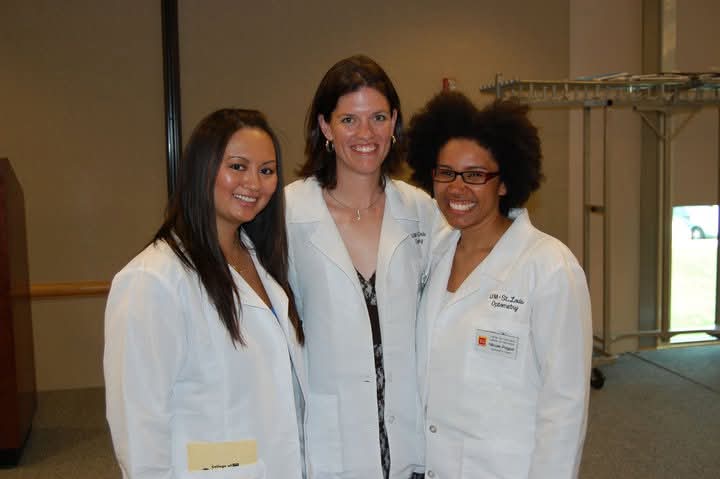
Dr. Pogue and classmates during their White Coat Ceremony at UMSL
“I knew that a residency would be a great opportunity to learn from preceptors while treating patients as an OD,” Dr. Pogue explains. “I wanted to soak in all the knowledge from other practicing ODs to be able to bring that experience back to St. Louis and establish an eye department within a community health center to create easier access to care and a ‘one-stop-shop’ for patients in that area.”
Adjusting to Residency
For some residents, balancing the space between new grad and practicing OD is an unexpected experience. While interacting with students on their clinical rotation can feel like a familiar situation, it’s when students seek you out for feedback or instruction that you’re reminded that you are the resident, and in fact a doctor.
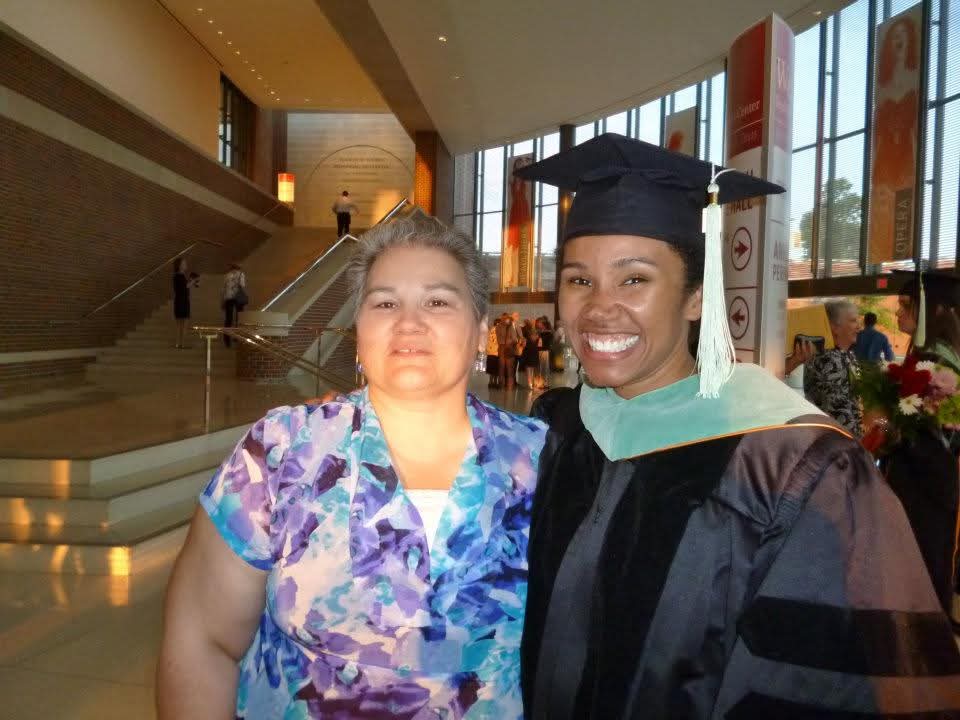
Dr. Pogue and her Mother after graduation at UMSL
“The students really made my residency experience unique at Dimock,” remembers Dr. Pogue. “I wasn’t expecting the experience of still feeling like an optometry student and realizing that I was actually a doctor. After a few months, I found that I really enjoyed interacting with and teaching the students. It was such a great and unique experience to know we were both growing and learning alongside each other.”

Dr. Pogue realized she wanted to stick around Boston and NECO’s community health center network to fully combine her passion of integrative patient care with teaching. Treating patients within an established teaching network meant she could remain a lifelong learner and continue to learn from practitioners new ways of teaching and treating.
“A few months into living in Boston and working at Dimock, I immediately fell in love with the area and working within the NECO clinical network,” shares Dr. Pogue.
“Learning from the many NECO preceptors and instructors, like Dr. Jacky Kong, opened my eyes to treating patients from a more evidence-based approach and how I can integrate the many specialty areas of optometry into my practice.”
Being exposed to this way of practice as a resident is one of the main reasons she loves overseeing students and other residents at Dimock today.
Both the optometrist and the patient are interacting with a whole care team, and as a resident, you are exposed to all of this. Just as the patient is receiving a one-stop-shop for care, so too is the practitioner.
Teaching and Treating at Dimock
Since her residency, Dr. Pogue has worked in private practice and at Codman Square Health Center. However, it was students in clinical rotations at these locations that made her miss the teaching aspect of optometry. So when a position opened up at Dimock she jumped at the opportunity to oversee patients and students again.
Since 2020, Dr. Pogue has been the Clinical Director of Optometry Services at the Dimock Center in Roxbury. She has seen countless patients receive the highest quality of care and students grow confident in their knowledge and passion for optometry.
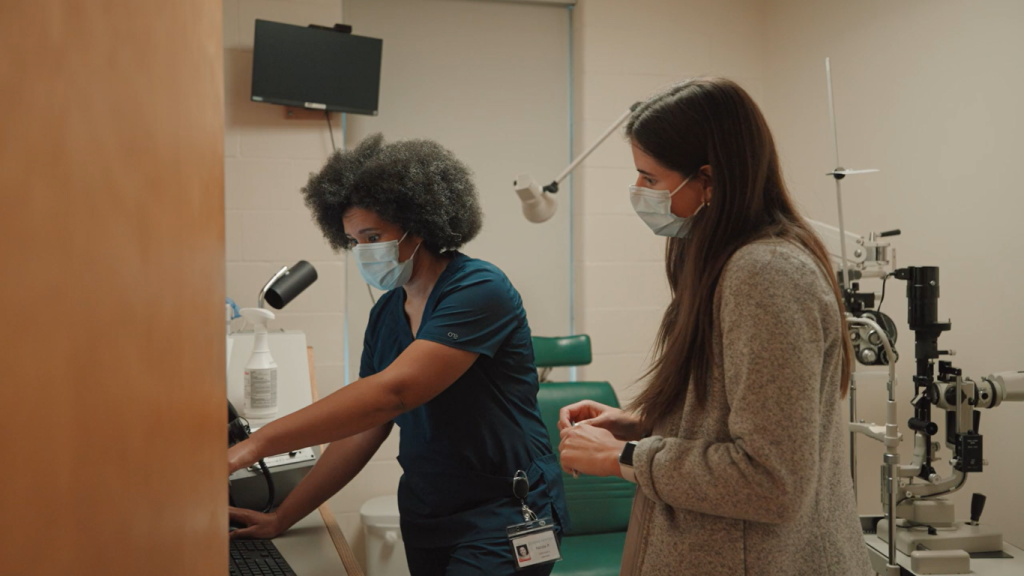
“My favorite part of this job is seeing the students grow throughout the semester,” explains Dr. Pogue. “I get to witness students transition from data collectors to clinicians-in-training, and how they become more comfortable in making decisions for their patients.”
“In the beginning of the semester, students will bring us the patient data and notes and ask us what to do next, but by the middle to end of the semester they are not only bringing us the data, they are bringing us their idea of how they would treat the patient. It’s really the best transition.”
The Dimock Center provides residents the opportunity to see many different ocular diseases and learn from specialists in areas they hadn’t previously considered. For Dr. Pogue, and anyone in clinical teaching, the goal is always to provide students and residents with a well rounded experience and knowledge of the many aspects of eye care.
Residents Make Great Students and Doctors
Looking back on her residency experience, Dr. Pogue sees how choosing Dimock directly impacted her life. The interaction with students and other preceptors changed how Dr. Pogue saw herself as an optometrist. While she committed to absorbing all the expertise of her preceptors, she was happy to experience how sharing her knowledge with students greatly impacted her plans for the future.
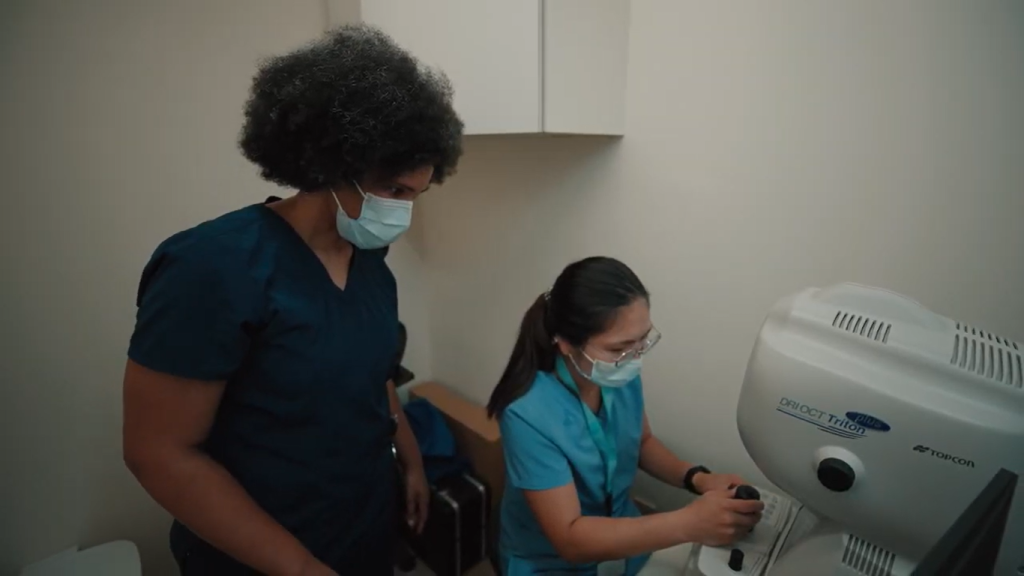
“My advice for anyone considering a residency, is to see the experience with an open mind and understand that your interests and motivations may evolve as you engage with patients and doctors,” advises Dr. Pogue. “Don’t let the fear of not matching keep you from discovering new passions.”
Being a resident is a unique experience that allows you to teach students while also learning from instructors and specialists. As Dr. Pogue shares, “Take advantage of this time and ask every question you have. Being a sponge led to my current role where I get to teach and learn every day.”
Learn more about residencies or community health here at NECO and around the country. If you have more questions about applying for NECO residencies, contact Dr. Nicole Quinn.

