

Braille as Modern Digital Assistive Technology
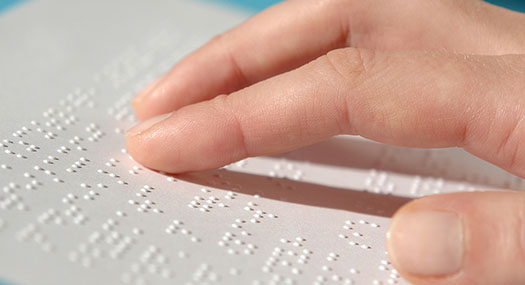
For 200 years, braille has remained a steadfast tool in supporting and promoting literacy for millions of people. Throughout he centuries, it is still as accessible as ever through modern digital assistive devices.
History

Louis Braille. Courtesy of National Federation of the Blind
The history of braille dates back all the way to the 19th century. It was invented by a French man named Louis Braille, who lost his eyesight at the age of three from an accident that led to total blindness in both eyes. Louis Braille was a highly intelligent individual who excelled in his studies, and received a scholarship to France’s Royal Institute for Blind Youth. As a student, he began developing a system of tactile code that would allow blind individuals to read and write in a highly efficient manner.
Louis Braille went on to become a Professor at the Institute and a musician. He continued to refine and expand on the braille system, even developing a braille code for music. Louis Braille published his first book about braille in 1829. Despite the braille system going obsolete after his death in the mid 1850s, it eventually gained popularity throughout Europe and was translated into many different languages. Braille was officially adopted by schools of the blind in the United States in 1916. By 1932, a formal English braille code was developed and finalized.
What is Braille?
Braille consists of cells made up of up to six dots, arranged in two columns of three. By varying the number and position of the dots, different letters, numbers, punctuation, and even music notation can be communicated. By using one’s sense of touch, individuals can guide their fingertips across the page to feel the configuration of dots and interpret them quickly and efficiently to formulate words, sentences, math equations, musical compositions, and more.
Courtesy of the American Foundation for the Blind
The Importance of Braille
Braille has been around for nearly 200 years, yet it is still a critical form of communication for many visually impaired, blind, and deafblind individuals. While audio is an alternative for those with intact hearing, braille offers many advantages, such as allowing equal access to the written world that sighted people have, and allowing for self-expression in a written form of communication.
Braille also provides greater independence as individuals can read braille signage in public spaces, keypads, and labels on medicines and packaged items. Understanding braille also allows for letters, bank statements, and other important documents to be provided in a written format, foregoing the need for a sighted person or device to convert text to speech.
As a learning tool, braille is critical for developing an understanding of spelling, grammar, and punctuation. Braille also allows for full engagement with any text, especially when explaining complex concepts. Such engagement is key to greater reading comprehension compared to audio formats. This is particularly critical for learning math and science, as these subjects are heavily reliant on symbols, equations, charts, and tables, which can all be adapted in a braille format.
Modern Technologies Utilizing Braille
Digital assistive technology has evolved to meet and exceed today’s modern society. This technology has allowed braille to become an effective and efficient form of everyday communication for those who are visually impaired, blind, and deafblind.
Refreshable braille displays are electronic devices which convert digital text into braille by using small pins that move up and down to form individual braille characters. A braille display can show up to 80 characters and is refreshable. The display changes continuously as the user moves their cursor around the screen, or by using other accessibility commands. This allows individuals to read text from websites and emails on electronic devices such as computers, phones, and tablets.
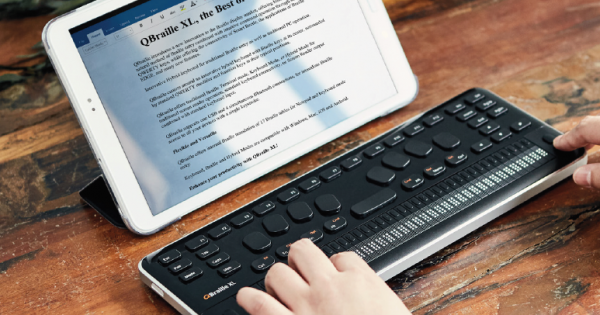
Braille notetakers are compact portable devices that use a braille keyboard and a refreshable display screen to allow an individual to take notes. Many of these devices have a text-to-speech function as well. Notes can be stored on the device, and some models even have wifi and cloud storage capabilities. These devices minimize the need to use paper or audio recording devices for the storage of information. Many devices contain a simple word processor, calendar, address list, and email capabilities.
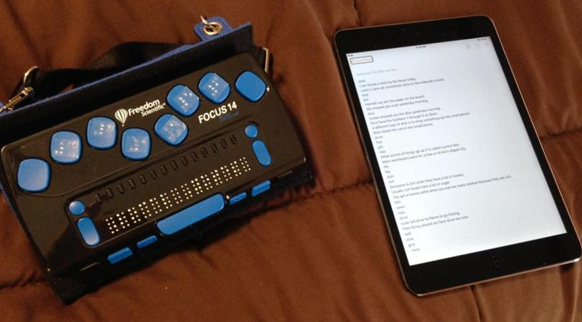
Braille E-readers convert digital books which are downloaded from online libraries into braille. This way, any book can be read in braille. These devices may be borrowed through some local libraries.
Smartphone apps such as TalkBack for Android and VoiceOver for iOS allow for bluetooth-enabled refreshable braille displays to be connected to smartphones so that users can send messages, use apps, and browse the internet using braille. Users are able to explore the outline and formatting of text, making it a superior option to text to audio converters.
From Louis Braille’s groundbreaking invention to its integration into modern technology, braille has remained a cornerstone of accessibility, empowerment, and equal opportunity for blind, visually impaired, and deafblind individuals. As technology advances, so too will braille’s role in breaking down barriers and enhancing independence. With the rise of artificial intelligence and adaptive learning tools, the future holds exciting possibilities for braille assistive devices, paving new paths toward even greater accessibility and inclusion.