


What is Age-Related Macular Degeneration?

Age-related macular degeneration (AMD) is the leading cause of vision loss in individuals over 50. It affects central vision and significantly impacts daily life. This progressive eye disease targets the macula, the part of the retina responsible for sharp, detailed vision. AMD only affects a person’s central vision, so it won’t directly cause total blindness. The peripheral vision remains intact, leading to what is called a scotoma, or a blindspot, in the center of one’s field of vision.
How a person with AMD might see their surroundings.
Two Primary Types of AMD
1. Dry AMD (More Common)
The more common type of AMD, results when the retina cannot properly process waste like dust. This causes the collection of irritants in the retina, called drusen, which leads to retina dysfunction and eventual vision loss.
2. Wet AMD (Less Common, but More Severe)
This severe type of AMD appears when abnormal blood vessels grow under the retina. The retina sends out a signal due to the lack of oxygen and nutrients it receives from the accumulated drusen, leading to abnormal blood vessels. As these vessels begin to grow, they become dysfunctional and leak blood and fluids, leading to significant vision loss.
What Does the World Look Like with AMD?
AMD patients often have reduced visual acuity, affecting their ability to see small details at a range of distances. They typically have impaired contrast sensitivity, where letters that are higher in contrast (like black letters on white paper) are quite easy to see, but objects that are less contrasted or more faded (like grey text on white paper) things become impossible to see.
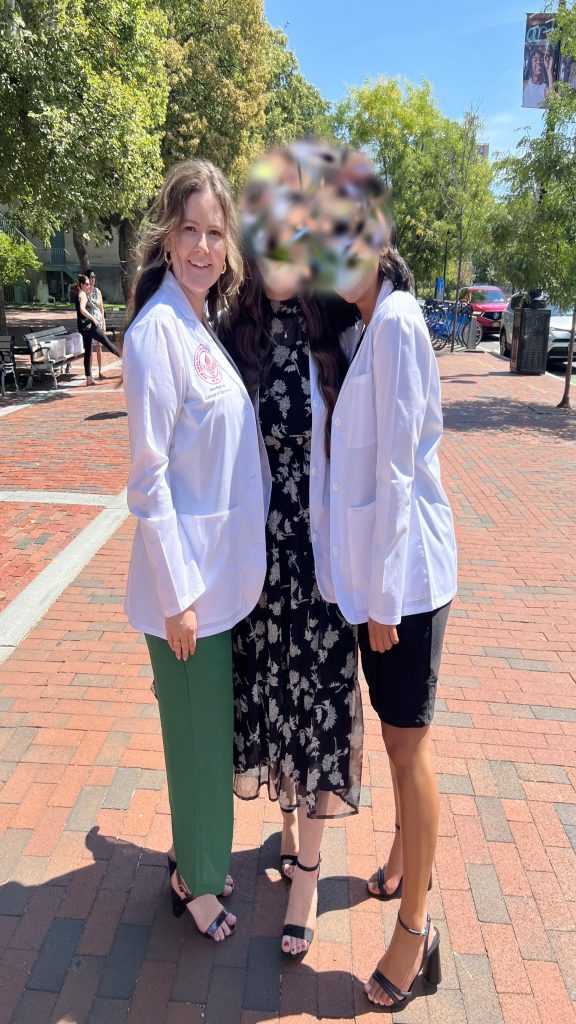
When a scotoma obstructs the retina, a person may have difficulties seeing details of something (or someone) up close.
Another typical symptom is a blind spot, or “scotoma,” encircling the part of the eye responsible for detailed vision. This blind spot can be particularly troublesome. It obstructs the view of whatever is directly in front of someone. This can be particularly frustrating for patients when things pop in and out, or appear to move around their direct line of vision.
Key Risk Factors
The exact cause of AMD is not completely understood. It is thought that it is a collective result of several factors. Things like normal aging, a diet low in antioxidants, smoking, excessive sunlight or UV exposure, and family history, seem to have the highest risk of developing AMD. While there’s no cure, several treatments have been shown to slow progression.
Treatment Options
It is critical to make lifestyle modifications after being diagnosed with AMD, like smoking cessation and wearing UV protection when outdoors. Eating natural antioxidants from dark leafy green vegetables can also be beneficial. However, more specific treatment options depend on which type of AMD you have.
Dry AMD Treatments
For people with dry AMD, there are different injectable drugs that are FDA approved for treatment of advanced cases. However, they have not become a regular treatment, as many retinal specialists do not find the benefits outweigh the risks for treatment at this time.
Supplements like AREDS2 are also an option. They contain vitamins C and E, zinc, copper, and antioxidants called lutein and zeaxanthin. This formula has been scientifically proven to slow the progression of moderate dry AMD.
Wet AMD Treatments
In wet AMD, eye injections can stop any leakage and slow or stop progression of vision loss. Landmark studies on these injections were published about 10 years ago. Optometrists are now seeing new generations of these treatments that could have the potential to reduce the frequency injections.

For patients at a specific stage of macular degeneration, a special vitamin formulation has shown to reduce further progression. However, many patients with wet AMD do not have a prognosis that would respond to the formulation.
“Over the past decade, our understanding of AMD and available treatment options have greatly improved,” shares Dr. Micaela Gobeille, NECO Assistant Professor of Optometry, Attending Optometrist NECO Center for Eye Care and The Carroll Center for the Blind.
“While there is no cure for AMD, we are seeing patients with better vision and functional ability than before. I look forward to seeing how treatment options continue to develop in the future.”
Strategies for Living with AMD
Patients with AMD often have significant problems accomplishing daily activities due to their vision loss, but low vision rehabilitation can help patients continue to accomplish important activities with independence.
Low Vision Rehabilitation
Low vision rehabilitation provides strategies to maximize any remaining sight and help patients keep living a safe, independent life. Patients often struggle to visually focus on objects or information directly in front of them. Low vision rehab teaches them a technique called “eccentric viewing.” It helps patients strategically move their eye around to find a position where the blind spot is out of their way. Many patients learn how to do this organically over time, but a low vision specialist will help them to more effectively see.
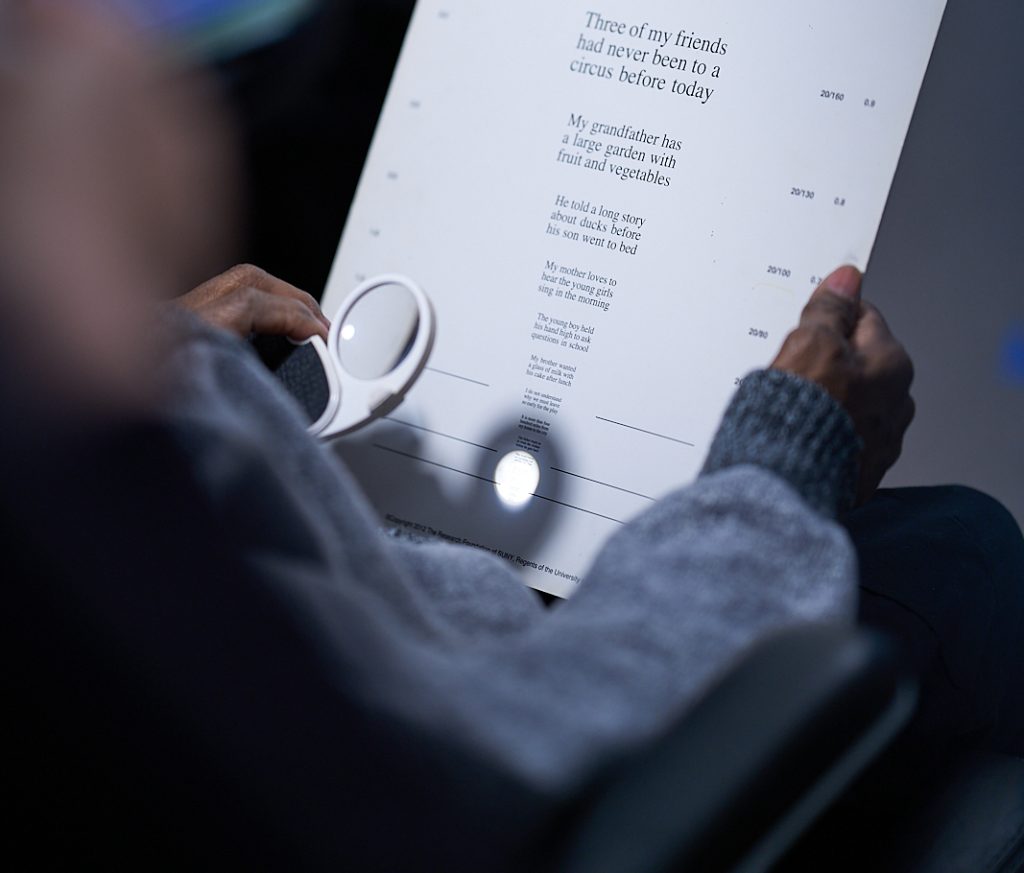
Another intervention is lighting. Closely illuminating an object can help compensate for reduced contrast sensitivity. Having direct task lighting can make all the difference. Along with lighting, magnification is another mainstay of low vision rehabilitation. Optical and electronic magnifiers can be used for reading and other activities to make objects appear larger. This helps to compensate for reduced visual acuity and makes it easier to work around a blindspot.
“With larger text, the scotoma will block fewer letters at a time,” describes Dr. Gobeille. “Making it easier for patients to work around their blindspot. In the low vision clinic, we often spend time evaluating different magnifier types to find the best fit for a patient’s unique wants and needs.”
Other Services
Some patients may find it difficult to manage medication or prepare daily meals, working with an occupational therapist can be helpful to identify strategies to mitigate these difficulties.
Patients who experience difficulty getting around their environment for vision-related reasons may benefit from orientation and mobility training, where they learn non-visual skills to compensate for their vision loss when walking. There are a range of different services available to help patients with AMD maintain their independence.
Patient Journeys
Learning how to live with AMD can be quite challenging. For doctors and student interns, learning to support and listen to their patients is key.
Students and faculty often hear from patients with AMD that they can’t see the faces of their loved ones or read their favorite books anymore. Doctors and interns are watching as patients pivot their entire way of living due to this disease.
However, they also are able to see what a difference the devices and learned compensating strategies have made for patients throughout their daily lives. They are able to once again enjoy their hobbies and socializing with loved ones.
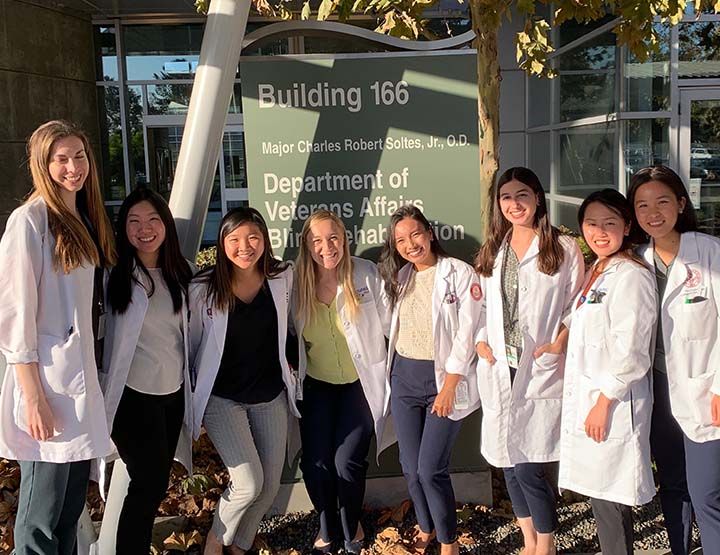
“Patients are able to use their magnifiers to see their pill bottles, and use their CCTV devices to enhance contrast and print size to read their mail,” shares a fourth year OD/MS student who recently completed a rotation at a VA hospital. “It was an incredibly rewarding experience to be able to help these veterans continue to do the things they enjoy in life and regain their sense of independence.”
Resources that Make a Difference
AMD patients are also treated at NECO’s Janet LaBreck Center for Low Vision by a team of Low Vision Specialists. Including Dr. Nicole Ross, Associate Professor of Optometry, Attending Optometrist at NECO, Perkins School for the Blind, and The Carroll Center for the Blind. The team works together to create customized treatment and exercise protocols for patients at all stages of AMD.
One patient who recently came in was a sight-reading musician struggling to read sheet music due to a central scotoma. To address his visual challenges, Dr. Ross and her team conducted a comprehensive assessment of his visual needs. They helped him register with the Massachusetts Commission for the Blind (MCB) to access essential assistive devices.

The above images illustrate how the patient relies on eccentric fixation to see more clearly, meaning they must use peripheral vision instead of their fovea. As a result, individuals with AMD may appear to avoid eye contact or look slightly off to the side when focusing on someone. In these photos, the fovea is obscured by atrophic areas that appear hyperfluorescent. The blue dots indicate the patient’s fixation points, which shift above or below the central vision.
Devices included bioptic telescopes and eSight, an innovative digital low-vision device designed to enhance central vision. The Low Vision team continues to support and monitor his progress in order to ensure he has access to appropriate low vision services. The patient also maintains regular visits with a retinal specialist for sight-preserving treatment for their AMD.
Patients who are legally blind can greatly benefit from working with state services for the blind. For example, the MCB offers a host of services to support patients in maintaining their independence by collaborating with providers and developing a plan of action to make sure each patient is fully supported. Connecting with a state association can help access resources including low vision devices, transportation, support groups, and legal benefits.

These images show fundus photographs of Dr. Ross’s musician patient, highlighting the effects of geographic atrophy caused by dry AMD. The atrophy is centered over the fovea, resulting in significant central vision loss. The black- and-white image is an autofluorescence scan, which enhances the visibility of atrophic areas. These regions appear HYPOfluorescent due to cell death, while surrounding areas of HYPERfluorescence indicate cells in the process of deteriorating. Additionally, drusen are visible, further illustrating the disease’s progression.
“For patients newly diagnosed with AMD,” shares Dr. Nicole Ross. “I would encourage them to maintain regular care with their optometrist and/or retinal specialist.”
“It’s important to follow your doctor’s recommendations on treatment options. Since there are different categories and severities of AMD, treatment has to be customized to each patient.”
If a loved one was recently diagnosed, it’s important to support them by offering assistance with daily living tasks. For example, some patients will no longer meet the legal requirements for driving, so offering a ride to the grocery store, medical appointments, or to run errands may be a big help. AMD presents and progresses differently in each individual, ranging from near normal vision to legal blindness, so it is best to simply ask if and how you can support them.

